
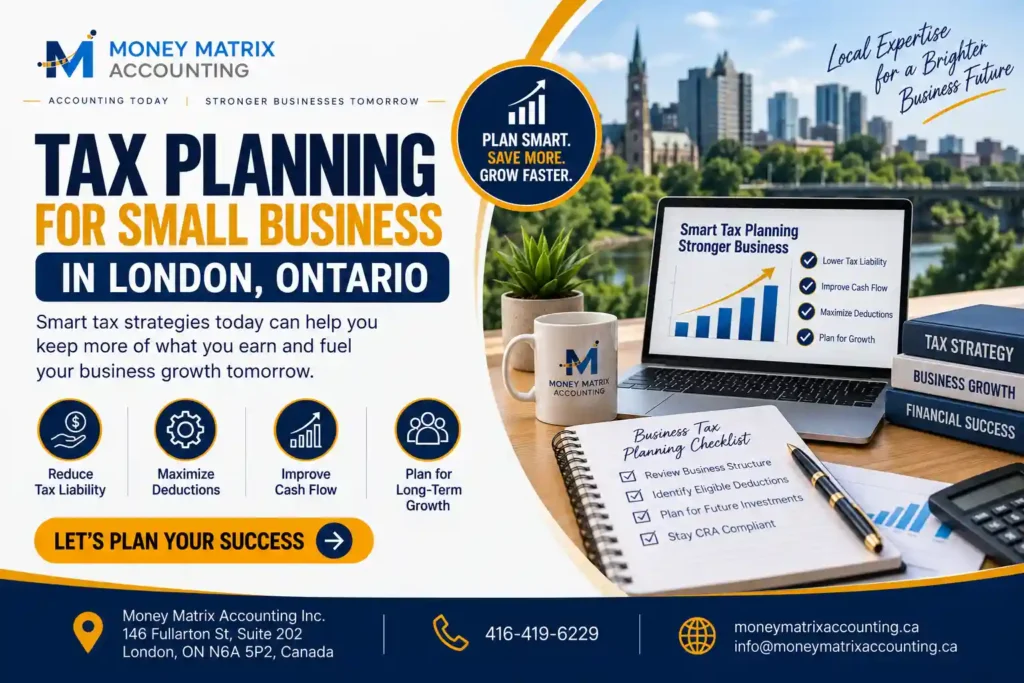
Running a small business in London, Ontario comes with many responsibilities, and managing taxes is one of the most important. Effective tax planning can help business owners prepare for tax obligations, identify eligible deductions, and make informed financial decisions. In this blog, we’ll explore practical tax planning strategies that can help small businesses stay organized and plan for the future.
Why Tax Planning Matters for Small Business Owners
Tax planning is the process of organizing your business finances and making informed financial decisions to manage tax obligations efficiently. For small business owners in London, Ontario, it involves understanding eligible deductions, keeping accurate records, and preparing for corporate and personal tax responsibilities.
Most owners think about tax once a year, in the weeks before a filing deadline. By then, the decisions that actually affect your tax position — how you paid yourself, when you bought equipment, how you structured your business — have already been made. Planning moves that conversation forward, to a point where you still have options.
The Importance of Planning Ahead for Taxes
Planning ahead changes what’s possible. When you know your estimated tax position part-way through the year, you can:
- Time capital purchases so the deduction lands in the year it helps most
- Set aside the right amount for installments instead of guessing
- Decide on salary versus dividends before the fiscal year closes
- Catch bookkeeping gaps in Q2, when they’re still easy to fix
Waiting until year-end narrows your choices to whatever’s left. Planning ahead keeps them open.
How Tax Planning Supports Business Financial Health
Tax isn’t a separate line item from the rest of your business — it affects cash flow, borrowing capacity, and how much you can reinvest. A business with a clear tax plan knows what’s actually available to spend. A business without one is often surprised by a bill it has to finance.
Consistent tax planning also produces something lenders and buyers care about: clean, reliable financial records. That matters whether you’re applying for a line of credit or eventually preparing to sell the business.
7 Effective Tax Planning Strategies for Small Businesses
1. Keep Accurate Financial Records
Everything else on this list depends on this one. Without clean books, you can’t claim deductions with confidence, estimate what you owe, or respond quickly if the CRA asks a question.
Practical steps:
- Separate business and personal bank accounts and credit cards
- Reconcile monthly, not annually
- Keep digital copies of receipts — the CRA accepts them
- Use consistent categories so year-over-year comparisons actually mean something
If monthly reconciliation keeps sliding down your list, professional bookkeeping services usually cost less than the deductions and time lost to disorganized records.
2. Track Eligible Business Expenses and Tax Deductions
Small business tax deductions are often missed not because owners don’t qualify, but because the expenses were never recorded properly. Commonly overlooked categories include:
- Home office costs (a reasonable portion of rent, utilities, and internet)
- Vehicle expenses, supported by a mileage log
- Professional fees, software subscriptions, and industry memberships
- Meals and entertainment (partially deductible)
- Capital cost allowance on equipment and technology
The rule of thumb: if an expense was incurred to earn business income, it’s worth tracking and asking about. Record it now, sort the eligibility later with your accountant.
3. Understand Your Business Tax Obligations
Different structures carry different obligations, and mixing them up is a common source of penalties. Depending on your situation, you may be responsible for:
- Personal income tax on business income (sole proprietors and partnerships)
- Corporate tax (T2) if you’re incorporated — due six months after year-end, with payment due earlier
- GST/HST registration and remittance once you pass the small supplier threshold
- Payroll deductions — CPP, EI, and income tax — if you have employees
Knowing your deadlines is half the battle. Missing them is one of the most avoidable costs a small business absorbs.
4. Plan for Corporate and Personal Taxes Together
For incorporated owners, corporate and personal tax aren’t separate problems — they’re two halves of the same decision. How you draw income from the business affects both.
Salary creates RRSP room and CPP contributions but is taxed as personal income. Dividends avoid payroll deductions but don’t build RRSP room. The right mix depends on your income level, retirement plans, and the corporation’s profit. This is a conversation worth having with a professional annually, because the right answer changes as your business does.
Our corporate tax filing services and personal tax filing are handled together for exactly this reason.
5. Review Your Business Structure
Sole proprietorship is simple and inexpensive to run, but every dollar of profit is taxed as personal income. Incorporation adds cost and complexity but brings access to the small business deduction, income timing flexibility, and liability protection.
There’s no universal threshold, but if your business is consistently earning more than you need to draw personally, it’s worth reviewing. If incorporation makes sense for your situation, our company registration services cover both federal and provincial setups.
6. Prepare for Year-End Tax Filing
Year-end goes smoothly when the work has already been done. A month before your fiscal year closes, you should be able to:
- Reconcile all accounts and clear outstanding items
- Review accounts receivable and write off genuinely uncollectible amounts
- Decide on any capital purchases you want in this fiscal year
- Confirm payroll and payroll remittances are current
- Estimate the tax owing and confirm the cash is set aside
None of this is complicated. It’s just much harder to do retroactively.
7. Work With a Professional Tax Accountant
A professional’s value isn’t just filing the return correctly — it’s being available before you make a decision that affects your taxes. Buying a vehicle, hiring your first employee, taking on a large contract: all of these have tax implications that are easier to plan for than to unwind.
There are also real advantages to working with a local tax accountant in London, Ontario who understands the regional business landscape and is reachable when you need an answer quickly.
Conclusion
Effective tax planning can make a significant difference in how small businesses manage their finances. By keeping accurate records, understanding tax obligations, and planning ahead, business owners in London, Ontario can make more informed financial decisions. Working with a professional tax accountant can provide the guidance and support needed to manage business taxes with confidence.
Contact Money Matrix Accounting Inc. for professional tax planning and accounting services in London, Ontario. Book a free consultation and get a clear picture of where your business stands — before the next deadline arrives.