
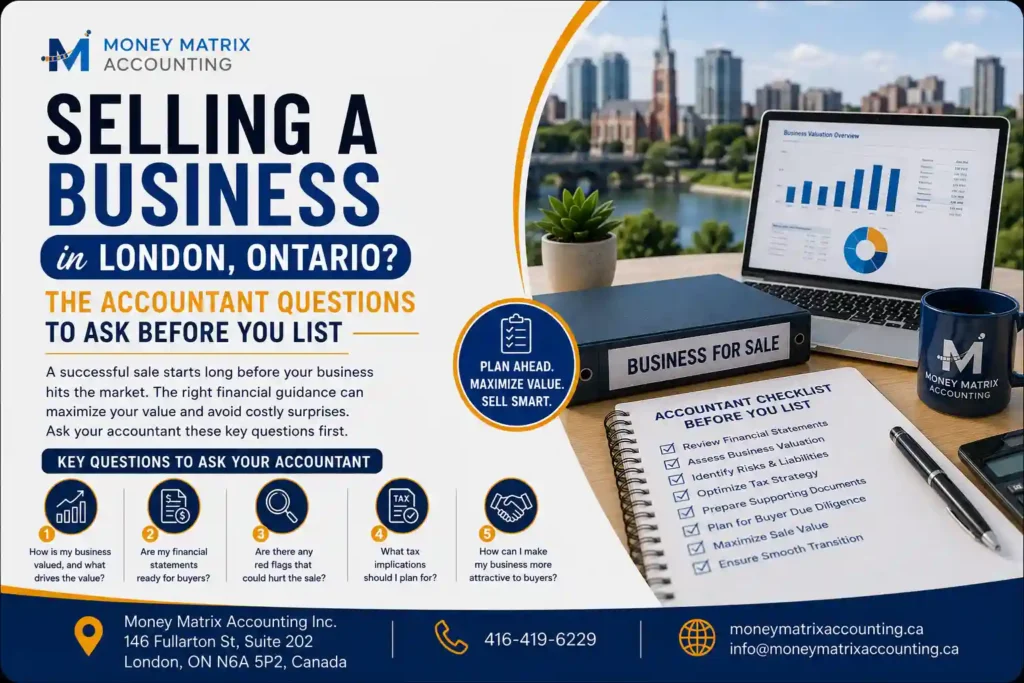
You’ve built something. Now you’re thinking about what comes next — retirement, a new venture, or simply handing the reins to someone else. But before a single “For Sale” sign goes up (figuratively speaking), there’s a conversation that matters more than almost anything else in the process: the one with your accountant.
Most business owners in London, Ontario start their exit journey by talking to a business broker or a lawyer. That’s not wrong — but it’s often backwards. The accountant conversation should come first, because the tax structure you choose, the timing you pick, and the way your books are prepared can swing your final payout by tens of thousands of dollars, sometimes more.
This isn’t a listicle. It’s the advisory conversation you’d have across the table from a tax accountant in London, Ontario who’s walked other owners through this exact process — the questions you should be asking, and the ones your accountant should be asking you.
Why Timing Your Exit Matters More Than You Think
Selling a business isn’t a single event — it’s the final chapter of years of financial decisions, and timing touches almost all of them. If you’re planning to sell within the next 6 to 24 months, the clock is already running on a few things:
- Fiscal year alignment — selling mid-year can complicate your final corporate tax filing and create two partial-year returns instead of one clean one.
- Multi-year averaging — buyers and their lenders typically want to see 2–3 years of clean, consistent financials. If this year is messy, it drags down your valuation story even if last year was strong.
- Personal tax planning — the year you sell often becomes your highest-income year ever. Coordinating that against RRSP room, other income sources, and provincial tax brackets needs runway, not a last-minute scramble.
- Life insurance and corporate-owned policies — if your corporation holds life insurance, the timing of a sale can affect the capital dividend account (CDA) credit you’re entitled to.
A good business succession accountant in London, Ontario will ask: “What’s your ideal sale date, and does your corporate structure actually support that timeline?” If nobody’s asked you that yet, it’s the first sign you need a second opinion.
Share Sale vs. Asset Sale: The Tax Difference That Can Cost You Thousands
This is, hands down, the most misunderstood part of selling a business — and it’s where owners lose real money if nobody explains it clearly upfront.
In a share sale, the buyer purchases your shares in the corporation itself — they take over the whole legal entity, including its history, contracts, and liabilities. In an asset sale, the buyer purchases specific assets of the business (equipment, inventory, client lists, goodwill) while your corporation continues to exist, and the sale proceeds land inside the company rather than in your hands directly.
Buyers usually prefer asset sales (cleaner liability picture); sellers usually prefer share sales (better tax treatment, including access to the lifetime capital gains exemption). That tension is exactly why this needs to be negotiated with tax outcomes in mind, not just price.
Share Sale | Asset Sale | |
What’s sold | Shares of the corporation | Specific business assets |
Who typically prefers it | Seller | Buyer |
Access to Lifetime Capital Gains Exemption | Yes, if eligible | No |
Liabilities transferred to buyer | Yes, including unknown/historical | Generally no |
Tax paid by | Seller (personal, on share proceeds) | Corporation (on asset gain), then seller (on withdrawal) |
Due diligence complexity | Higher — buyer inherits everything | Lower — buyer picks specific assets |
Common in | Owner-managed businesses with clean corporate history | Businesses with legal/liability risk, or where buyer wants select assets only |
Neither structure is universally “better” — it depends on your corporate history, your eligibility for exemptions, and what the buyer is willing to negotiate. This is exactly the kind of decision that should be modelled out with real numbers before you’re mid-negotiation and out of leverage.
Not sure whether a share sale or asset sale makes more sense for your business? Our team can walk through both scenarios with your actual numbers in a 15-minute call.
Are You Eligible for the Lifetime Capital Gains Exemption?
The Lifetime Capital Gains Exemption (LCGE) is one of the most valuable — and most misapplied — tax provisions available to Canadian business owners selling qualifying small business shares. For 2026, the exemption shelters a significant portion of capital gains from tax entirely, per individual.
But it’s not automatic. To qualify, your shares generally need to meet tests around:
Not sure whether a share sale or asset sale makes more sense for your business? Our team can walk through both scenarios with your actual numbers in a 15-minute call.
- Qualified Small Business Corporation (QSBC) status — at least 90% of your company’s assets need to be used in an active business at the time of sale.
- The 24-month holding test — throughout the 24 months before the sale, at least 50% of the corporation’s assets must have been used principally in an active business.
- Ownership — the shares must have been owned by you, your spouse, or a related person for that same 24-month period.
Here’s where it gets tricky: many businesses accumulate excess cash, investments, or non-active assets over the years (a healthy problem to have, but a real one for LCGE purposes). If your corporation is “impure” — holding too much passive investment or non-business assets — you may not qualify without doing cleanup work first.
This is a question every capital gains exemption small business Canada strategy needs answered well before you list, because fixing eligibility issues takes time — sometimes a full 24-month cycle.
Cleaning Up Your Financials Before Due Diligence Begins
Buyers (and their accountants) will look at your books harder than the CRA ever has. A due diligence accountant in Ontario isn’t just checking that your numbers add up — they’re checking that your numbers tell a believable, defensible growth story.
Common red flags that slow down or derail deals:
- Personal expenses run through the business (common, but it muddies true profitability)
- Inconsistent revenue recognition year over year
- Undocumented related-party transactions
- Owner compensation that doesn’t reflect market-rate work (buyers want to know what it actually costs to run the business without you)
- Messy or incomplete bookkeeping records in the final 12–24 months
Cleaning this up isn’t a one-week job. It’s a structured process — normalizing your financial statements, documenting owner add-backs clearly, and making sure your bookkeeping and corporate tax filings are airtight for at least the past two to three fiscal years. The earlier this starts, the more leverage you keep in negotiations.
What Happens to Retained Earnings and Shareholder Loans?
Retained earnings and shareholder loans are two line items that quietly complicate almost every business sale — and they’re rarely discussed until it’s late in the process.
Retained earnings: If your corporation has built up significant retained earnings, a buyer in an asset sale may not want to “pay” for that cash sitting on your balance sheet — they’ll expect it distributed to you before closing, which triggers its own tax event (often a dividend). Planning the timing and method of that distribution matters.
Shareholder loans: If you’ve drawn funds from the corporation as a shareholder loan, it needs to be repaid or properly accounted for before or at closing — otherwise it becomes a sticking point in the purchase and sale agreement, and can trigger unexpected income inclusions if it’s been outstanding too long.
Both of these need to be untangled well ahead of listing, not negotiated on the fly during closing week.
Should You Restructure Before You List? (Corporate Reorganization Basics)
For some owners, the right move before a sale isn’t just cleanup — it’s a corporate reorganization. This might include:
- A holding company structure, moving excess passive assets out of the operating company to help preserve QSBC/LCGE eligibility
- An estate freeze or family trust, allowing family members to each access their own capital gains exemption on a future sale (multiplying the exemption across the family)
- Separating real estate from operations, if your business owns its building, since real estate and operating assets often shouldn’t be sold together
- Cleaning up historical share classes, especially in older corporations with layers of amendments over the years
Corporate reorganization before a sale is technical, and it needs to happen with enough runway — generally well over a year before closing — for the tax benefits to actually apply. This is where a business succession accountant earns their fee many times over.
Free Download: Pre-Sale Financial Checklist for London, Ontario Business Owners — a practical starting point for what to review before you talk to a buyer.
Working With Your Accountant, Lawyer, and Business Broker as a Team
A business sale isn’t a solo project, and it isn’t a two-person job either. The strongest outcomes happen when three advisors are coordinated from early on:
- Your accountant models the tax structure, prepares clean financials, and confirms LCGE eligibility.
- Your lawyer drafts and negotiates the purchase and sale agreement, including reps and warranties, and reviews tax clauses like vendor take-back financing terms.
- Your business broker or M&A advisor manages valuation positioning, buyer outreach, and negotiation strategy.
The mistake owners make most often is looping in the accountant after a letter of intent is signed — by then, the deal structure is already set, and it’s much harder (and more expensive) to fix a tax-inefficient structure than to build it correctly from the start.
Frequently Asked Question
What's the difference between a share sale and an asset sale?
How much of my business sale is tax-free with the capital gains exemption?
When should I start exit planning before selling my business?
What is vendor take-back financing, and does it affect my taxes?
Do I need a business valuation before I list my business for sale?
Can my accountant help even if I haven't found a buyer yet?
Conclusion
Selling a business in London, Ontario is very likely a once-in-a-lifetime financial event — and the difference between a well-planned exit and a rushed one often comes down to the questions asked (and answered) before the business ever hits the market. Timing, sale structure, capital gains exemption eligibility, clean financials, and coordinated advisors aren’t nice-to-haves — they’re the foundation of a sale that actually protects what you’ve built.
If you’re 6 to 24 months out from listing, now is the time to have this conversation — not after a buyer is already at the table.
Thinking about selling your London business? Book a confidential exit-planning consultation with Money Matrix Accounting Inc. before you talk to a buyer.
One Response