
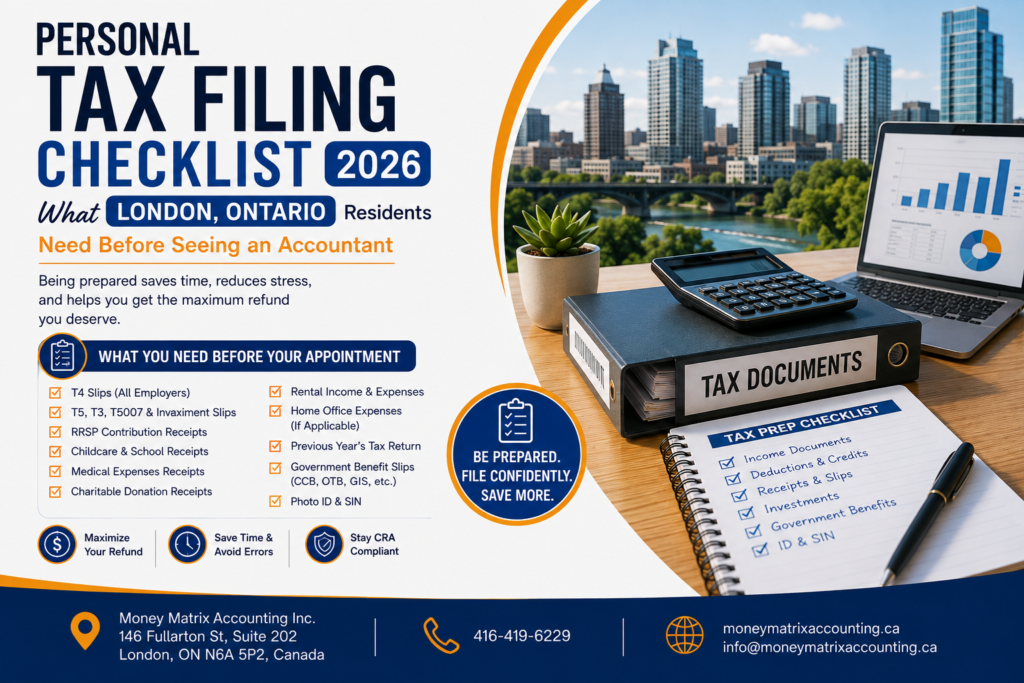
Every tax season, the same thing happens in accounting offices across London, Ontario: a client sits down, opens a grocery bag full of receipts, and says, “I think this is everything.” It usually isn’t.
The good news is that a solid personal tax filing checklist takes about twenty minutes to put together — and it can shave real time (and real dollars) off your appointment. Below is exactly what to gather before you see a personal tax accountant in London, plus the deadlines and credits that actually move the needle on your 2026 return.
First, Let's Clear Up the Confusion: Personal Tax vs. Corporate Tax Filing
This is the single most common mix-up we hear from clients in London — especially freelancers, contractors, and small business owners. “Personal tax” and “corporate tax” sound like they might overlap, but the CRA treats them as completely separate filings with different forms, different deadlines, and different rules.
Personal Tax Filing (T1) | Corporate Tax Filing (T2) | |
Who files it | Individuals, sole proprietors, freelancers, employees | Incorporated businesses (Ltd./Inc.) |
Form used | T1 General return | T2 Corporate Income Tax Return |
Filing deadline | April 30 (self-employed: June 15, balance still due April 30) | 6 months after your fiscal year-end |
What’s reported | Employment income, self-employment income, investments, credits | Company revenue, expenses, and corporate deductions |
Tax rate applied | Personal marginal tax rates | Flat corporate tax rate |
The quick test: if you’re a sole proprietor or freelancer who hasn’t incorporated, your business income still flows through your personal return. Once you’re incorporated, the business itself needs a separate corporate tax return in London, Ontario.
If you’re not sure which bucket you fall into — self-employed, incorporated, or a high-net-worth filer juggling both personal and business income — that’s genuinely one of the most common questions a personal tax accountant in London fields, so don’t stress over getting it perfect before your appointment.
The 2026 Personal Tax Filing Checklist
Here’s what to have on hand — digital or paper, doesn’t matter — before you sit down with your accountant.
1. T4 Slip Checklist
- T4 (employment income) from every employer you worked for in 2025
- T4A (pension, scholarship, or self-employment commission income)
- T4E (EI benefits)
- T4RSP / T4RIF if you withdrew from an RRSP or RRIF
2. CRA Tax Slips List (Beyond T4s)
- T5 slips for investment income (interest, dividends)
- T3 slips for trust income
- T5008 for securities transactions
- Rental income statements
- Self-employment/business income records (invoices, expense logs)
3. Personal Tax Return Documents
- Last year’s Notice of Assessment (NOA)
- Social Insurance Number(s) for you and any dependents
- Direct deposit banking info for faster refunds
- Any CRA correspondence received during the year
4. RRSP Contribution Deadline 2026
The RRSP contribution deadline for the 2025 tax year is March 2, 2026. Contributions made up to that date can still be deducted on your 2025 return, so pull together your RRSP contribution receipts before your appointment — this is one of the most overlooked ways to lower a tax bill at the last minute.
5. FHSA Contribution
If you opened a First Home Savings Account, bring your FHSA contribution receipt. Like an RRSP, FHSA contributions are tax-deductible, and unused contribution room carries forward — worth flagging even if you didn’t contribute the full amount.
6. Tax Credits Ontario 2026
A few of the credits people in London most often forget to claim:
- Medical expense tax credit — prescriptions, dental work, physio, and travel for medical care (keep every receipt, even small ones; they add up fast)
- Tuition tax credit — T2202 forms for yourself or a dependent enrolled in post-secondary study
- Charitable donation receipt tax credit — official donation receipts, not just bank statements showing the transfer
- Ontario Trillium Benefit and Climate Action Incentive documentation, if applicable
- Childcare expense receipts
7. Income Tax Preparation Checklist — The Final Sweep
Before your appointment, do one last pass for:
- Home office expense records (if you worked remotely)
- Moving expense receipts (if you relocated for work or school)
- Support payment records (spousal or child support paid or received)
- Any capital gains or losses (crypto, stocks, property sales)
Mapping Your Situation to the Right Service
Not every filer needs the same thing, and this is where a lot of DIY tax software falls short:
- Employed, straightforward income: A standard personal tax filing service covers T4s, credits, and RRSP optimization.
- Self-employed or freelance (unincorporated): Still a personal return, but with business income and expense tracking layered in — this is where good bookkeeping throughout the year saves real time in April.
- Incorporated business owners: You’ll need both a personal return and a corporate tax filing, plus attention to how salary vs. dividends are structured between the two.
- High-net-worth filers: Investment income, trust structures, and estate considerations often mean personal tax and trust or estate planning need to be looked at together, not separately.
This is exactly the kind of situation where a combined accounting relationship pays for itself — one team that sees your personal filing, your corporate filing, and your bookkeeping together tends to catch things a once-a-year, drop-in tax preparer simply won’t. It’s the approach we take at Money Matrix Accounting: rather than treating your T1 as an isolated form, we look at how your personal and business finances connect so nothing falls through the cracks between filings.
Frequently Asked Questions
1. What documents do I need to file my taxes in Ontario?
2. What's the RRSP contribution deadline for 2026?
3. Do I file personal or corporate tax if I'm self-employed?
4. What tax credits am I probably missing in Ontario?
5. When is the personal tax filing deadline in Canada?
6. Do I need an accountant if I only have a T4?
Conclusion
A clean tax filing starts before you ever sit down with an accountant — it starts with the checklist above. Gather your slips, sort your receipts by category, and know which return (or returns) actually apply to your situation. That alone puts you ahead of most filers walking through the door in April.
And if your tax picture is a little more layered than one T4 — self-employed income, an incorporated business, or investments alongside your personal filing — that’s exactly the kind of year-round clarity Money Matrix Accounting is built around. Talk to a Money Matrix Tax Expert before the season gets busy, and walk into filing season with a plan instead of a grocery bag of receipts.