

Running a business in London, Ontario comes with more than day-to-day operations — it comes with a standing appointment with the Canada Revenue Agency (CRA) and the province of Ontario. If you’ve ever typed “what are my Corporate Tax Obligations in London, Ontario” into Google at 11 p.m. before a deadline, you’re not alone. Between T2 returns, HST remittances, payroll deductions, and instalment payments, it’s easy for a growing business to lose track of what’s due, and when.
This guide breaks it all down in plain language — what you owe, when you owe it, and how to keep your business penalty-free — with practical, London-specific guidance from the team at Money Matrix Accounting.
What Are Your Corporate Tax Obligations in London, Ontario?
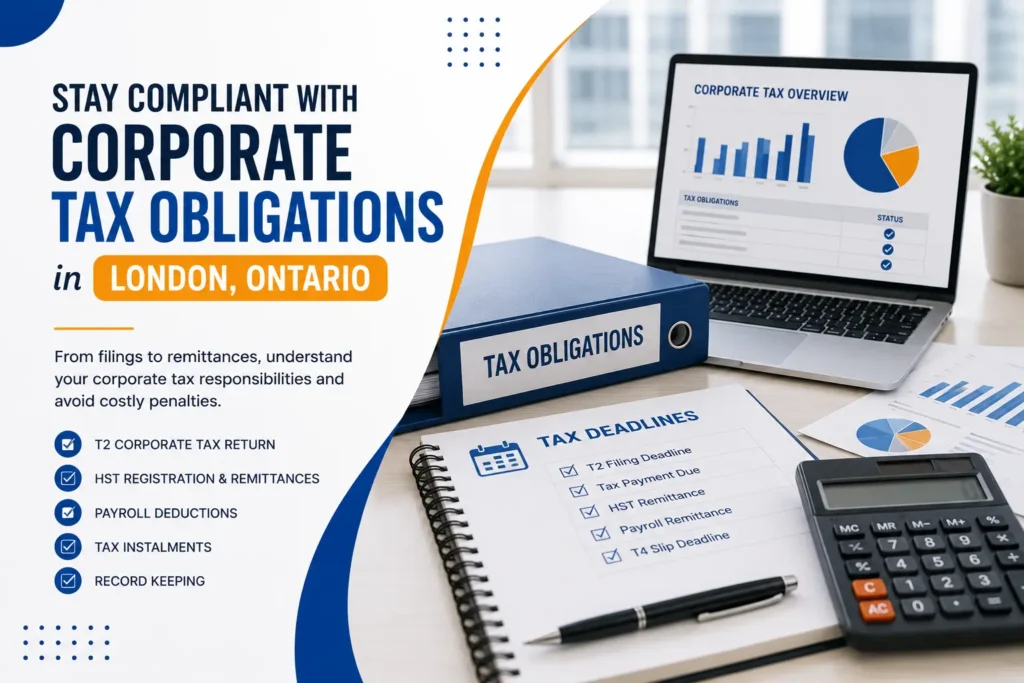

Every corporation registered in London, Ontario — whether it’s a home-based consultancy in Byron or a manufacturing unit near Highbury Avenue — must:
- File a T2 Corporation Income Tax Return annually with the CRA, even if the business had no income or activity
- Pay any balance of corporate tax owing, generally within two or three months of the fiscal year-end (depending on your corporation’s size and eligibility)
- Register for and remit HST (13% in Ontario) once taxable revenue crosses $30,000
- Deduct and remit payroll source deductions (CPP, EI, income tax) if you have employees
- Make quarterly or monthly tax instalments if your net tax owing exceeds CRA thresholds
- Keep organized financial records for a minimum of six years
There is no exemption based on business size, income level, or whether tax is owing — inactive and dormant corporations must still file a nil return.
Why Corporate Tax Filing in London, Ontario Deserves Your Attention
London’s business landscape — from advanced manufacturing and healthcare technology to retail and professional services along Richmond Row — is diverse, and so are the tax situations business owners face. A retail store collecting HST daily has very different obligations than a professional corporation billing quarterly, or a startup that hasn’t turned a profit yet.
Corporate Tax Filing in London, Ontario isn't just an annual chore — it directly affects your ability to:
- Access financing and business loans (lenders ask for CRA-filed T2s)
- Apply for government grants or subsidies
- Avoid compounding daily interest on unpaid balances
- Maintain good standing for future business sales or restructuring
- Sleep at night during tax season
Core Corporate Tax Obligations Every London, Ontario Business Must Know
1. Filing the T2 Corporate Income Tax Return
Every corporation resident in Canada must file a T2 return for each tax year, regardless of income level, and this includes CCPCs, holding companies, dormant companies, and shelf corporations. Your T2 return is due six months after your corporation’s fiscal year-end — for example, a December 31 year-end means your filing deadline is June 30 of the following year.
2. Paying the Balance of Tax Owing
Here’s where many business owners get tripped up: the payment deadline is earlier than the filing deadline. Canadian-Controlled Private Corporations (CCPCs) with a December 31 year-end must pay the balance of corporate tax owing by March 31, with interest accruing daily from April 1 onward. You can technically file your T2 as late as June 30 and still be on time — but if you owe tax and haven’t paid it by March 31, interest has already been building for months.
3. Registering for and Remitting HST
Ontario businesses must register for GST/HST once worldwide taxable revenue exceeds $30,000 in a single calendar quarter or over four consecutive quarters, and there’s a 29-day window to register from the date that threshold is crossed. Once registered, HST (13% in Ontario) must be charged, collected, and remitted to the CRA on the assigned filing schedule — monthly, quarterly, or annually depending on revenue.
4. Corporate Tax Instalments
If your corporation’s net tax owing is expected to exceed a certain threshold, the CRA requires quarterly or monthly instalment payments throughout the year rather than one lump-sum payment. Missing instalments — even if you eventually pay the full balance — can trigger instalment interest.
5. Payroll Source Deductions
Businesses with employees must deduct CPP, EI, and income tax at source and remit these to the CRA on a regular schedule (monthly or, for larger remitters, more frequently), along with issuing T4 slips by the required deadline each year.
6. Recordkeeping
The CRA expects supporting documents — invoices, receipts, bank statements, payroll records — to be retained for at least six years from the end of the last tax year they relate to.
Key Corporate Tax Deadlines for London, Ontario Businesses
Obligation | Who It Applies To | Typical Deadline | Consequence of Missing It |
T2 Corporate Tax Return Filing | All resident corporations | 6 months after fiscal year-end | Late-filing penalty: 5% of unpaid tax + 1% per month (up to 12 months) |
Balance of Corporate Tax Owing | CCPCs claiming the small business deduction | Generally 3 months after fiscal year-end (2 months for some corporations) | Daily compounding interest from the day after the deadline |
HST Registration | Businesses crossing the $30,000 revenue threshold | Within 29 days of crossing the threshold | Retroactive HST liability plus penalties/interest |
HST Return Filing | Registered HST filers | Monthly, quarterly, or annually (CRA-assigned) | Penalties and interest on unremitted amounts |
Payroll Remittances | Employers | Monthly or per CRA remitter schedule | Penalties starting at 3% and rising with repeated lateness |
T4 Slips Issuance | Employers | Last day of February | Penalties per slip filed late |
Corporate Tax Instalments | Corporations above CRA thresholds | Quarterly (or monthly for large corporations) | Instalment interest charges |
Note: Deadlines shift to the next business day if they fall on a weekend or public holiday. This table is for general guidance — your specific dates depend on your fiscal year-end. Money Matrix Accounting can confirm your exact obligations based on your incorporation details.
What Changes for Ontario Businesses in 2026
Tax rules aren’t static, and 2026 brings a meaningful shift for London’s small business community. The 2026 Ontario Budget reduces the Ontario small business corporate income tax rate to 2.2% from 3.2% on the first $500,000 of active business income, bringing the total effective combined federal and provincial small business rate down to 11.2% from 12.2%, effective July 1, 2026. Corporations with a fiscal year that straddles July 1, 2026 will need to prorate — the old 3.2% rate applies to the portion of the year before July 1, and the new 2.2% applies after, working out to roughly 11.7% for the 2026 calendar year overall.
If your fiscal year-end doesn’t line up neatly with the calendar year, this is exactly the kind of detail worth reviewing with a professional before you file — it directly affects how much tax your corporation owes.
Common Mistakes London, Ontario Business Owners Make
- Assuming “no income means no filing.” Even dormant or zero-revenue corporations must file a T2.
- Confusing the filing deadline with the payment deadline. You can be “on time” for filing and still owe months of interest.
- Registering for HST late. Crossing $30,000 in revenue without registering within 29 days can create retroactive tax liability.
- Ignoring instalment requirements. Growing businesses often get caught off guard when the CRA requires quarterly instalments for the first time.
- Poor recordkeeping. Reconstructing a year of receipts during an audit is far more painful than staying organized from day one.
- DIY-ing complex corporate structures. Associated corporations, passive income rules, and manufacturing deductions all change your effective tax rate.
How Money Matrix Accounting Helps London, Ontario Businesses Stay Compliant
Navigating Corporate Tax Filing in London, Ontario doesn’t have to mean spreadsheets, CRA hold music, and last-minute stress. Money Matrix Accounting works with London-based corporations — from solo professional corporations to multi-location businesses — to:
- Track every filing and payment deadline specific to your fiscal year-end
- Prepare and file accurate T2 returns and HST filings
- Structure your corporation to take full advantage of the Small Business Deduction and the new 2026 Ontario rate reduction
- Manage payroll remittances and T4 preparation
- Calculate and plan for instalment payments so there are no year-end surprises
- Represent your business in CRA correspondence and, where needed, penalty relief requests
The goal isn’t just compliance — it’s giving you back the time and mental space to focus on running your business, while Money Matrix Accounting handles the numbers in the background.
Final Thoughts
Corporate tax compliance in London, Ontario isn’t about memorizing CRA rulebooks — it’s about having a system (and ideally, a team) that tracks deadlines before they track you. Whether you’re incorporating for the first time or you’ve been filing for a decade, staying ahead of your Corporate Tax Obligations in London, Ontario protects your business from penalties, keeps your financing options open, and frees you up to focus on growth.
Have questions about your specific filing deadlines or want a compliance check-up? Get in touch with Money Matrix Accounting — your London, Ontario partner for stress-free corporate tax filing.